
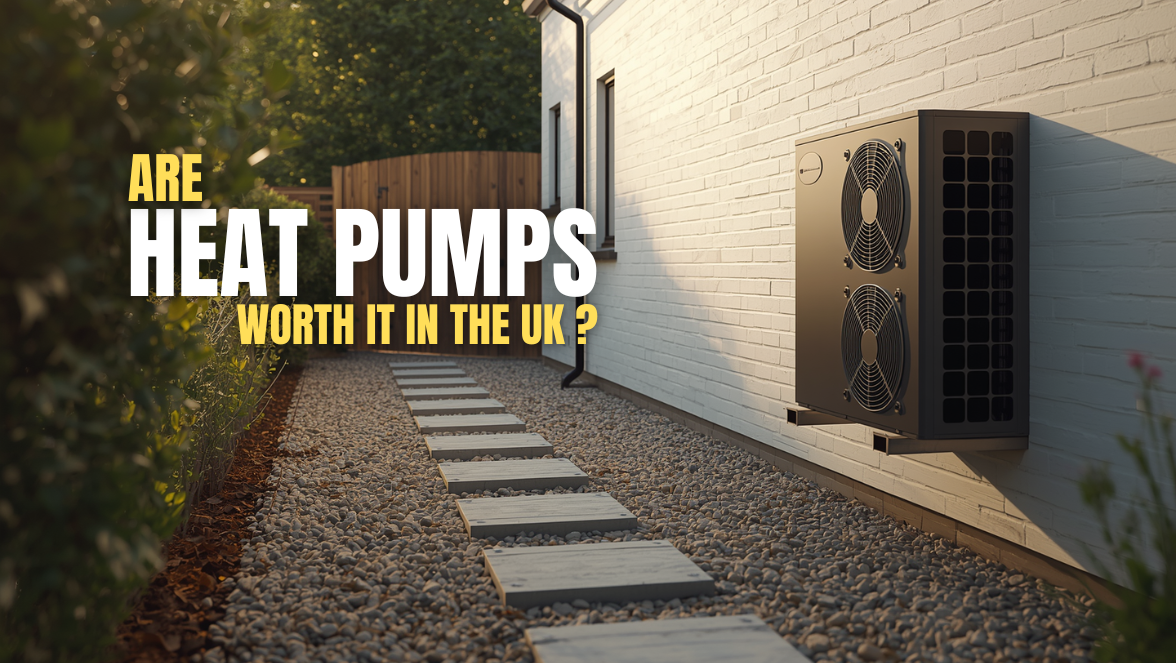
Are Heat Pumps Worth It in the UK?
More homeowners are searching are heat pumps worth it UK because the decision is no longer just about replacing a boiler. It is about long-term heating costs, lower emissions, future-readiness, and whether the numbers stack up for a real home rather than a showroom example. Energy Saving Trust says heat pumps are suitable for almost all types of home and, depending on what system you are replacing, they could save money on energy bills.
Featured snippet answer: In the UK, heat pumps are often worth it when the system is well designed, the home is reasonably well insulated, and you are comparing them with electric, LPG, oil, or older inefficient heating. They can be less compelling on simple bill savings alone if you already have a newer gas boiler, because electricity costs more per unit than gas.
Are Heat Pumps Worth It UK? The honest answer
For many households, yes. But not for every home, and not for every definition of “worth it”. Energy Saving Trust says heat pumps are generally cheaper to run than most other fuel types because they are much more efficient, but it also says that if you already have a newer gas or oil boiler, a heat pump is likely to be slightly more expensive to run because electricity costs more per unit. That is the real starting point. A heat pump’s value depends on what you are replacing, how well the system is designed, and how your home performs as a whole.
This is why the right question is not simply “Will I save money next month?” It is “What will this system cost to install, cost to run, and deliver over the next 15 to 20 years?” Heat pumps are a long-life, whole-home heating decision, not just a like-for-like boiler swap. Industry guidance commonly puts air source heat pumps in the 15 to 20 year range with proper care, while major UK boiler brands commonly describe boilers in the region of 10 to 15 years.
Do heat pumps really save money?
Sometimes yes, sometimes not, and that is exactly why this topic needs a balanced answer.
Energy Saving Trust says a heat pump can be cheaper to run than most other heating fuels because it delivers three to four units of heat for every unit of electricity used. But it also says newer gas or oil boilers may still be slightly cheaper to run, because gas and oil cost less per unit than electricity. That means heat pump savings UK are highly scenario-dependent rather than guaranteed.
The UK government’s heat pump campaign makes the same point in a practical way. In one modelled example using a standard three-bedroom detached house with good insulation, a typical heat pump, a smart tariff, and no gas standing charge in the heat-pump scenario, the annual running cost came out at roughly £1,900 for the heat pump versus about £2,000 for the gas boiler. That is a saving, but it is not a dramatic one, and it depends on the assumptions.
So the honest answer to “Do heat pumps really save money?” is this. They often do against electric resistance heating, LPG, oil, and older inefficient systems. Against a newer gas boiler, the savings case can be much tighter, and in some homes the value comes more from long-term stability, carbon reduction, and future-proofing than from headline annual bill cuts alone.
Upfront cost versus running cost
This is where many articles oversimplify the argument.
Energy Saving Trust says a typical air source heat pump installation costs around £11,000, while ground source systems are much higher. It also says the final price depends on property size, whether the home is new-build or existing, and how much work is needed to adapt the existing heating system.
That upfront cost is the biggest reason some homeowners hesitate. A gas boiler is usually cheaper to buy and install. A heat pump asks you to spend more at the start in exchange for better efficiency, a lower-carbon system, and the possibility of lower or steadier long-term heating costs. Government support can materially change that equation. In England and Wales, the Boiler Upgrade Scheme can reduce the cost of replacing a fossil-fuel system with a heat pump, and GOV.UK also provides a tool that compares potential cost and carbon savings for individual homes.
That is why payback cannot be judged from one national average. Two homes can have the same heat pump model and completely different financial outcomes because one needed radiator upgrades, the other did not, one uses a smart tariff well, and the other runs the system like a boiler.
Heat pump vs boiler by cost and value
| Factor | Heat pump | Boiler |
|---|---|---|
| Upfront installation | Higher | Usually lower |
| Running cost | Often lower than electric, LPG or oil. Can be close to or slightly higher than a newer gas boiler | Usually competitive on gas |
| Efficiency | Very high, often 300 to 400% in principle | Around 90% for an A-rated boiler |
| Lifespan | Commonly discussed around 15 to 20 years with proper care | Commonly discussed around 10 to 15 years |
| Maintenance | Annual service recommended | Annual service standard |
| Carbon impact | Lower-carbon heating | Fossil-fuel dependent |
The comparison above reflects Energy Saving Trust guidance on installation cost, efficiency, annual servicing and running-cost trade-offs, together with UK manufacturer and consumer guidance on typical lifespan ranges.
What affects whether a heat pump is worth it?
Insulation and draught-proofing
This is one of the biggest factors. The government’s clean energy campaign says most UK homes can be suitable for a heat pump and cites evidence that 90% already have enough insulation to run one, but it also says improving insulation and draught-proofing can reduce running costs. Citizens Advice makes the same basic point. A draughty home forces the system to work harder, which makes the financial case weaker.
System design and radiator setup
Energy Saving Trust says underfloor heating often works well with heat pumps and some homes may need radiator upgrades with a higher surface area. The government heat-pump campaign likewise says installers may recommend radiator upgrades to maximise efficiency. A heat pump can be very good value, but only if it is matched properly to the emitters and heat demand of the home.
Flow temperature and controls
Heat pumps tend to perform best when they do not have to run unnecessarily hot. Energy Saving Trust’s installer toolkit explains that weather compensation adjusts the flow temperature as outdoor conditions change, and that lower flow temperatures improve efficiency. Energy Saving Trust also warns that if the heating curve is not set correctly, running costs can rise. That makes heat pump return on investment partly a design-and-controls issue, not just a hardware issue.
Energy prices and tariffs
Your tariff matters. The government campaign notes that some suppliers offer time-of-use tariffs with cheaper off-peak electricity, and its modelled example used a smart tariff. The same system can look average on a standard tariff and much stronger on a well-used smart tariff.
Usage habits
A heat pump is not always best treated like a gas boiler that is turned sharply up and down. The government campaign says a heat pump works with a thermostat to maintain a comfortable temperature and automatically adjusts how hard it works depending on outdoor conditions. Homes that let the system run steadily often get a better result than homes that expect short bursts of very high-temperature heat.
When a heat pump is likely to be worth it
A heat pump is often a strong choice when:
- you are replacing electric heating, LPG, oil, or an older inefficient boiler
- your home is reasonably well insulated, or you are willing to improve it
- the installation is being designed properly rather than rushed
- you are looking at long-term heating savings, not only first-year savings
- you value lower emissions and a system aligned with the direction of UK heating policy
It can also be especially attractive when you are already doing renovation work, changing radiators, or planning the heating system more holistically. In those cases, the extra work heat pumps sometimes need is less disruptive because it is already part of the project.
If you are at the stage where you want numbers for your own property rather than generic national ranges, it makes sense to request a tailored quote based on your home, current heating system, and likely upgrade work.
When a heat pump may be less suitable, or slower to pay back
A heat pump may be less compelling on a strict money-only basis when:
- you already have a newer gas boiler that runs efficiently
- the property is poorly insulated and no fabric improvements are planned
- the design relies on very high flow temperatures to compensate for heat loss
- the system is badly specified or installed
- the homeowner expects simple boiler-style operation without adapting controls or usage
That does not automatically mean a heat pump is wrong for the home. It means the financial case may be slower, and the project may need a more thoughtful design approach.
How to judge ROI and payback realistically
The most useful way to assess air source heat pump value is to stop looking for one magic payback number.
Instead, look at five things together:
- upfront cost after any available support
- likely running cost against your current system
- expected maintenance, with annual servicing recommended for heat pumps
- likely lifespan
- whether your current system would need replacing soon anyway
This is important because “worth it” is rarely a simple spreadsheet answer. A home replacing ageing electric or oil heating may see obvious financial and comfort benefits. A home replacing a fairly new gas boiler may still choose a heat pump, but the value may be more about long-term heating savings, lower emissions, and avoiding another fossil-fuel replacement cycle later. GOV.UK’s heat-pump suitability tool is useful precisely because it compares both cost and carbon savings rather than pretending every house is the same.
If you want to talk through suitability, running costs, or what would need to change in your home before a switch makes sense, you can contact the team here for a more practical view.
Quick summary for skim readers
- Heat pumps are often worth it in the UK, but not for exactly the same reason in every home.
- They are usually strongest against electric, LPG, oil, and older inefficient heating.
- They can be a tighter financial case against a newer gas boiler.
- Upfront cost is higher, but grants and long lifespan help the wider value picture.
- Good insulation, correct radiator sizing, sensible controls, and lower flow temperatures all improve the economics.
- The best ROI comes from good design, not from buying the cheapest unit.
FAQ
Do heat pumps really save money?
Sometimes. Energy Saving Trust says they are generally cheaper to run than most other fuel types because they are so efficient, but it also says they may be slightly more expensive to run than a newer gas or oil boiler because electricity costs more per unit.
Are heat pumps cheaper to run than gas boilers?
They can be, but not always. UK government modelling found a modest running-cost advantage for a heat pump in one well-insulated detached-home scenario on a smart tariff, while Energy Saving Trust says a newer gas boiler can still be slightly cheaper to run in some cases.
How long does it take for a heat pump to pay back?
There is no single UK payback figure that fits every home. Payback depends on installation cost, any support available, what system you are replacing, your tariff, your insulation, and how efficiently the system is designed and run.
Do heat pumps need more maintenance than boilers?
Not really. Energy Saving Trust says they are about as much work to maintain as a gas boiler and recommends an annual service, which also helps identify issues early and can be important for warranty terms.
Are heat pumps worth it in older UK homes?
They often can be, but the design matters more. The government campaign says most UK homes are suitable, and improving insulation and draught-proofing can lower running costs. Older homes can still work well, but they are less forgiving of poor design.
Conclusion
When people ask are heat pumps worth it UK, the honest answer is that they are often worth it, but only when you judge them properly. A heat pump is not just a cheaper-or-dearer boiler replacement. It is a more efficient, lower-carbon heating system whose value depends on the home, the design, the controls, and what you are replacing. If you are moving away from electric, LPG, oil, or an older inefficient system, the case is usually stronger. If you already have a newer gas boiler, the savings case may be tighter, but the broader value can still be there in lifespan, comfort, carbon reduction, and future-readiness
Leave a Reply